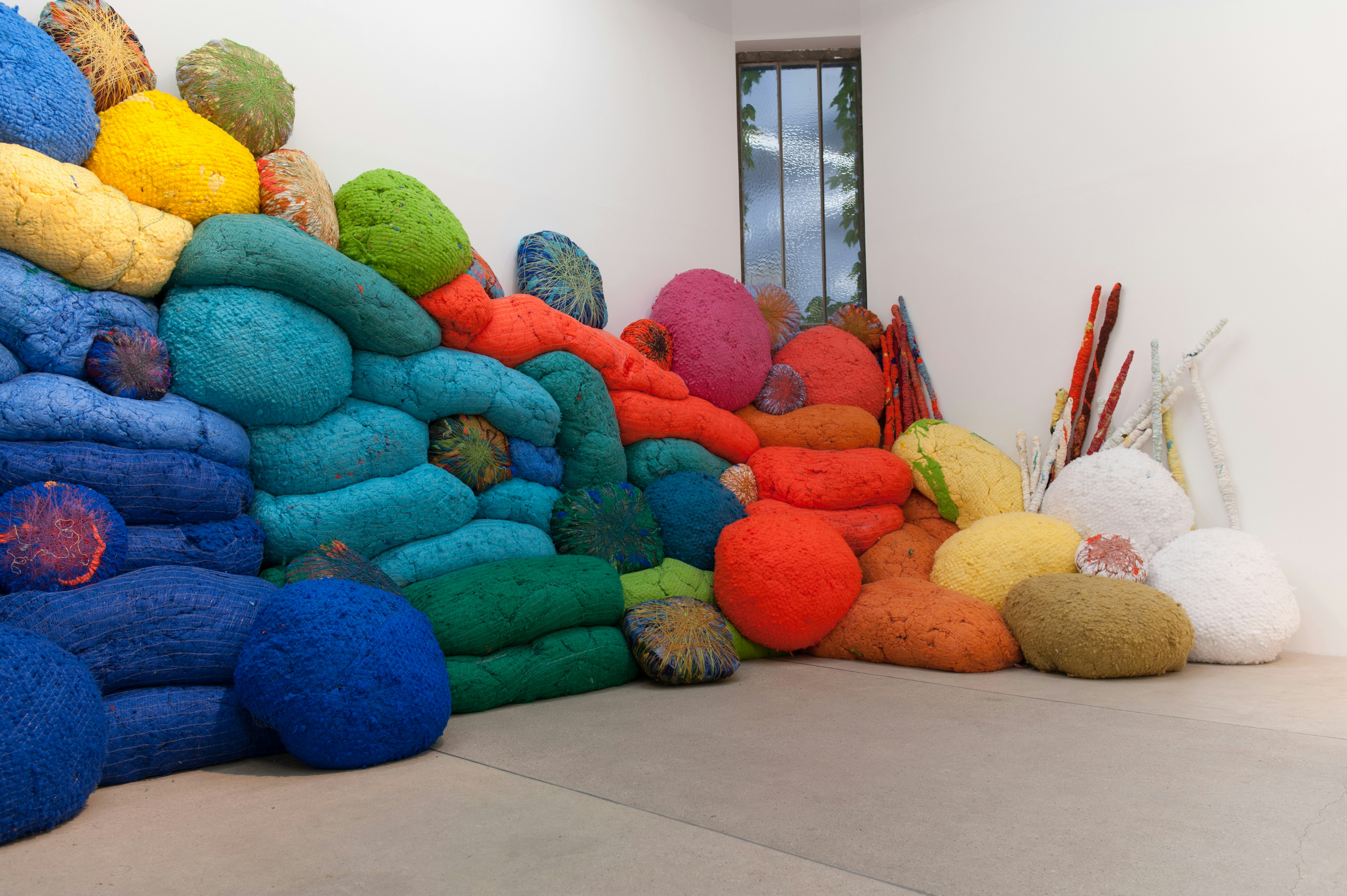
Sheila Hicks
Born into a family of traders of Scottish, Dutch, Welsh and Cherokee descent, Sheila Hicks enrolled at Yale University in 1954, where she studied under Josef Albers, a leading figure of the Bauhaus and renowned colour theorist, and George Kubler, a historian specialising in pre-Columbian art. These teachings would leave a lasting impression on her and encourage her to persevere along the path she was then forging – namely, the creation of textile works that blurred the boundaries between fine art and applied art in order to foster a union between art and life.
Indeed, whilst producing small paintings in the abstract expressionist style, Hicks began creating her first ‘Minimes’ as early as 1956 – tiny woven pieces that served as testing grounds for her future creations. To deepen her knowledge of weaving and embroidery techniques, she travelled throughout Latin America between 1957 and 1958, then spent a year in France, where she met Raoul d’Harcourt, a specialist in pre-Inca textiles whose writings would prove instrumental in the writing of her final-year dissertation.
After spending four years in Mexico, Hicks moved to Paris in the mid-1960s, where she has lived ever since, continuing her exploration of the intersection between art, design and interior design. Blending modernism, abstraction, traditions and non-Western craftsmanship, her sculptures and installations—made from wool, nylon, silk, linen or cotton—sometimes incorporate utilitarian objects, such as clothing, and can also become functional in their own right, defining spaces where visitors are invited to wander, lie down and relax. Sheila Hicks’s blurring of the distinction between works of art and utilitarian objects is also evident in the private and public commissions she received from the mid-1960s onwards: in particular, she created a collection of fabrics for Knoll (1965), textiles for hand-weaving workshops in India as part of the Commonwealth Trust (1966), and monumental decorations for companies such as CBS in New York (1966) and IBM in Paris (1972).
Whether they are hanging tapestries, stacks of large bales of fibre, cascades of colourful vines, columns of pigmented threads or flexible tubes around which wool is wound, her works give pride of place to the materials that dictate their forms. Subject to the laws of gravity and shaped by the architecture of the spaces that house them, her pieces hang vertically and bend horizontally when they touch the floor, standing upright and stabilising under the weight of their own mass, unfurling their colours throughout the space to alter our perception of it. Refusing to give his works any fixed or definitive form, Hicks creates his pieces with a focus on free experimentation, following the rhythm of the weaving process, with no purpose other than the work itself. Flexible and ephemeral, his sculptures foreshadow the movements of Anti-form and Post-Minimalism, for which textiles were a fundamental material.