News

The Fondation is currently closed. It will reopen on October 9th for the "Gustave Fayet, Collector - Designer. Icons of Modern Art" exhibition".

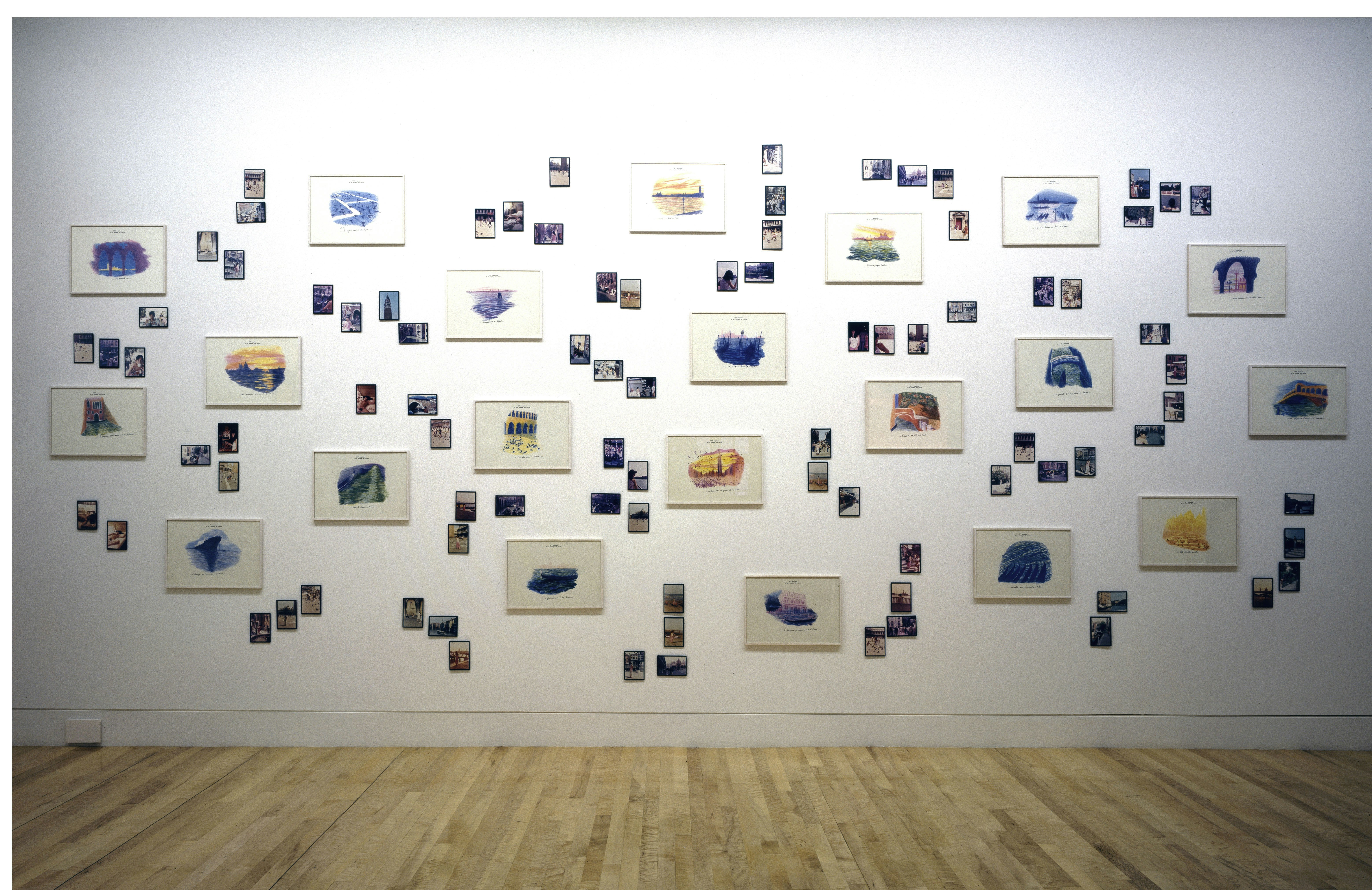
Le voyage de noces

  • 1975
  • Annette Messager, Christian Boltanski
  • Colored pencil and ink drawings and glossy chromogenic color prints
  • 21 drawings and 86 color prints

Autobiography is a constant in the art of Christian Boltanski and Annette Messager and appears in a work they made together, The Honeymoon (Le Voyage de Noces) (1975), a mural installation evoking a shared personal memory through twenty-one drawings and eighty-six color photographs.

© Adagp, Paris, 2020 Courtesy Marian Goodman Gallery, Paris

Hangs

Annette Messager

Annette Messager belongs to a generation of artists who, since the 1970s, have been rewriting the language of art.

Without stating a specific position, Messager asserts her dual identity as a woman and an artist. She creates characters that cultivate ambiguity: the Collectionneuse, the Truqueuse, the Amoureuse and the Femme pratique, whose imaginary lives are opportunities to expose prejudice and express what is usually left unsaid. In the 1980s Messager began to incorporate fragments of the body through photography, fur and puppets, inserting them in mechanised worlds, focusing on the emotive and symbolic charge of works that reflect the theatre of life in derisory, grotesque or dramatic fashion. In 2005, Messager received the Golden Lion at the Venice Biennale, where she represented France.

Read more

Christian Boltanski

Life and death, memory and forgetting are at the heart of his practice. Initially taking the form of reconstituted objects and grotesque sketches featuring himself, Boltanski began to record ordinary lives in 1969 – his own and those of anonymous people – using family photographs.

Taking on the fictional role of ethnographer, he created fake biographies that connect individual and collective experiences. DIY, cut-outs, stacked cardboard or rusty metal boxes, piles of clothes, shadow and light and projected images are among the resources he drew on to make his emotive installations, some temporary. The allusion to historical tragedies is transcended by a wider consideration of the fragility of human life. In 1972 Boltanski took part in Harald Szeemann’s legendary Documenta 5 exhibition, which developed the idea of individual mythology. Boltanski represented France at the 2011 Venice Biennale.

Read more

In the same hang