Alexander Calder
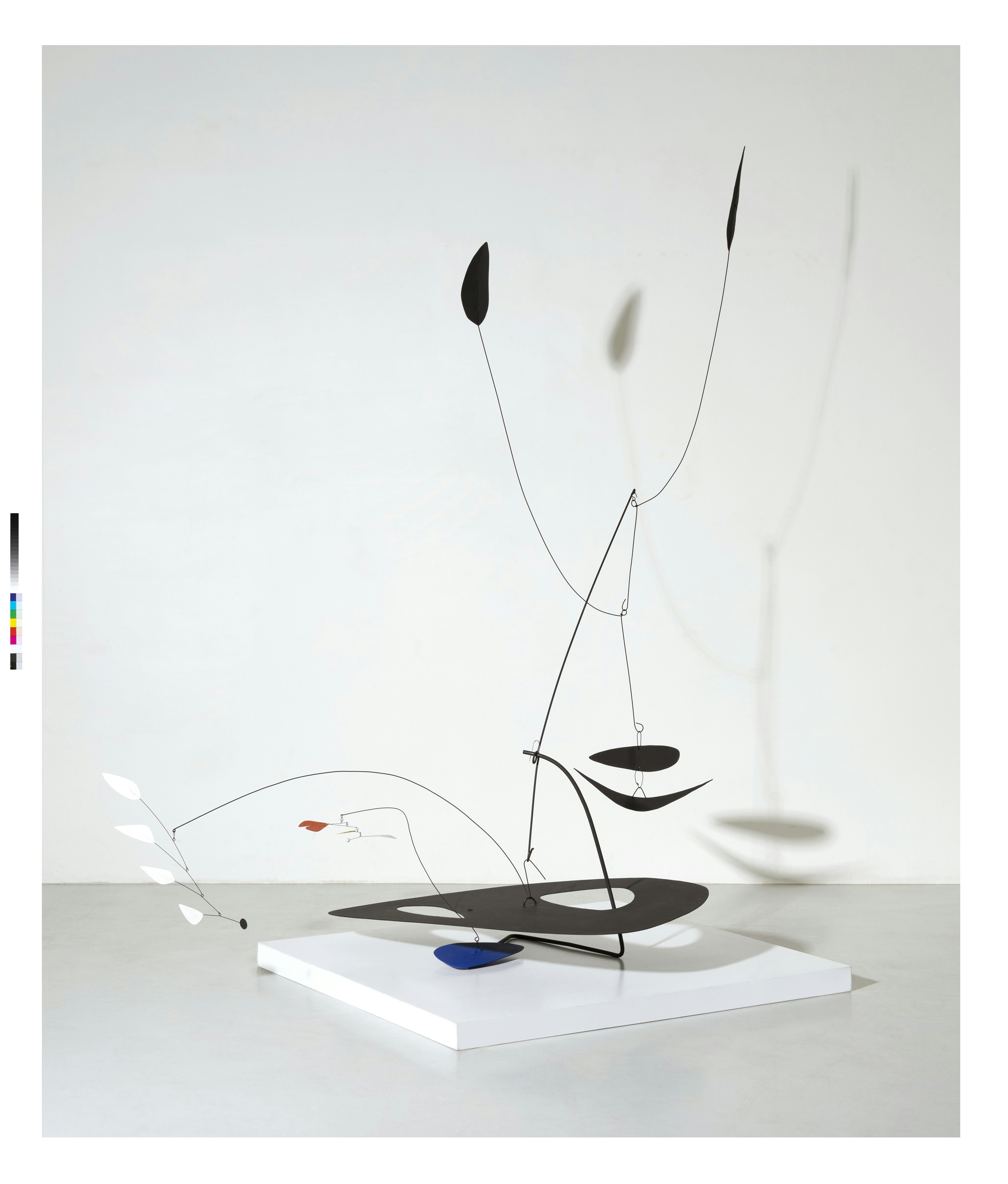
The American painter and sculptor Alexander Calder (22 July 1898, Philadelphia, USA – 11 November 1976, New York, USA) revolutionised the very concept of sculpture through his ‘stabiles’ and, above all, his ‘mobiles’ – ingenious assemblages of metal rods and coloured sheet metal that come to life at the slightest breath of air. ‘The sublimation of a tree in the wind’, according to Marcel Duchamp, to whom we owe the very term ‘mobile’ – and to Jean Arp, the term ‘stable’.
Born into a family of renowned sculptors and painters, Calder began training as an engineer before going on to study at the Art Students’ League of New York in the early 1920s. At the same time, he devoted himself to illustrating comic strips and sketching the animals at the Bronx Zoo and in Central Park. His fascination with the circus led him to design his own, made of wire and pieces of wood, which he took on tour around the world, particularly in Paris, where he settled in 1926. There he mingled with the Surrealists – Robert Desnos, Man Ray, Joan Miró and Jean Cocteau – as well as the proponents of geometric abstraction, such as Jean Hélion, Theo van Doesburg and Piet Mondrian. His visit to the latter’s studio on Rue du Départ in 1930 proved decisive for the rest of his career; from the master of Neoplasticism, he adopted a palette restricted to black and primary colours, and a vocabulary reduced to the simplest of forms.