Calder. Rêver en équilibre

- Place
- Fondation Louis Vuitton
- Hours
- 10.00 a.m.-8.00 p.m.
On the occasion of the centenary of Alexander Calder’s arrival in France and the fiftieth anniversary of his death, the Fondation presents the exhibition “Calder. Rêver en Equilibre.”
This exhibition spans half a century of creation, from the late 1920s and the first staging of the artist’s Cirque Calder performances that captivated the Parisian avant-garde, to the monumental sculptures that redefined public art in the 1960s and 1970s. At the Fondation, Calder’s mobiles – floating within Frank Gehry’s architecture – transform the exhibition into a choreographed dance.
One of the most important exhibitions ever dedicated to Alexander Calder, “Calder. Rêver en Equilibre” has been conceived in close collaboration with the Calder Foundation, its principal lender. The display also features loans from international institutions and leading private collectors, bringing together nearly 300 works: stabiles and mobiles – to use the Calderian terminology for static and kinetic abstractions – as well as wire portraits, carved wooden figures, paintings, drawings, and even jewelry, designed as unique sculptures. Throughout the chronological journey spanning more than 3,000 m2, the exhibition will highlight Calder’s fundamental artistic concerns: movement above all, but also light, reflection, humble materials, sound, the ephemeral, gravity, performance, and the interplay of positive and negative space.
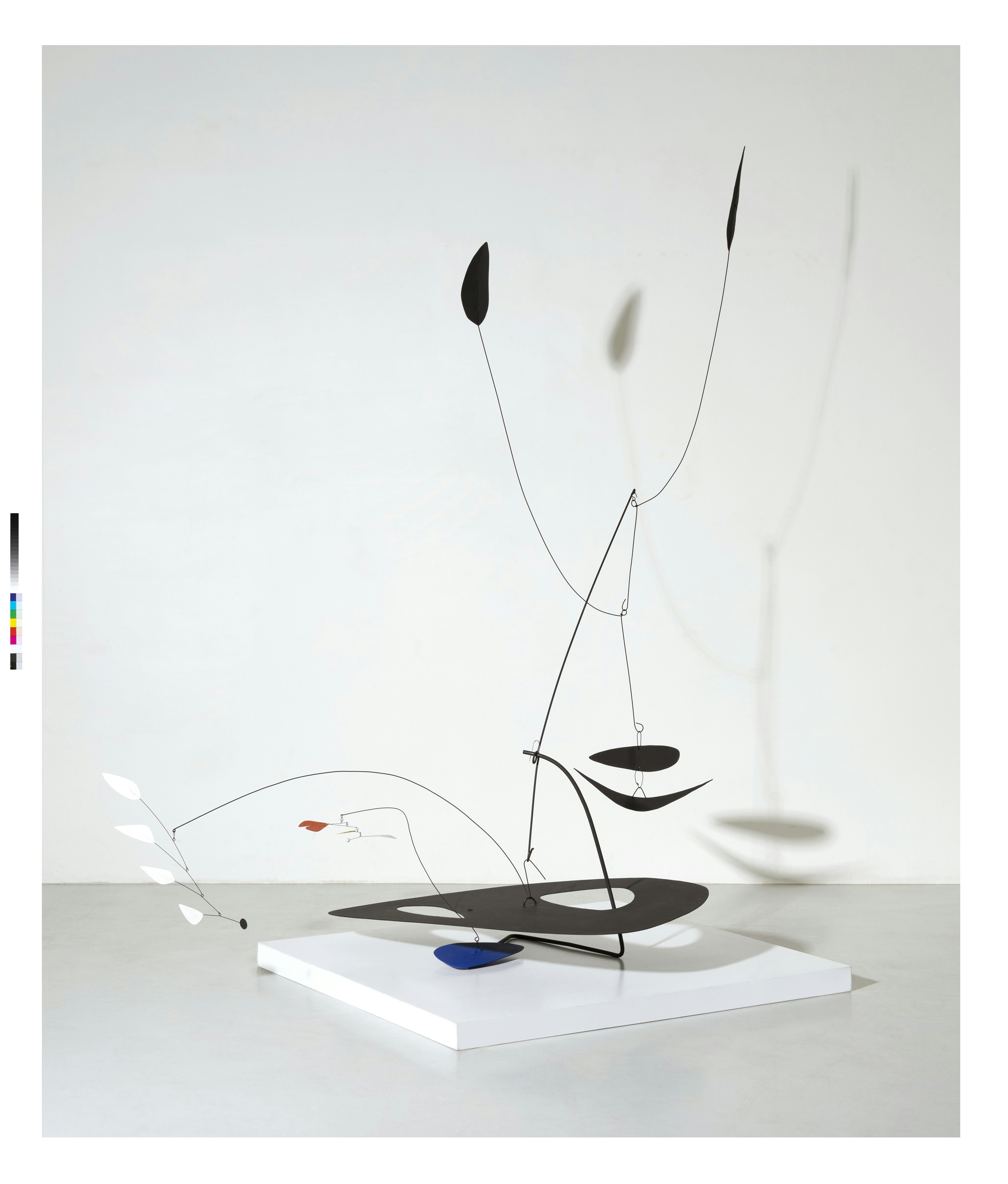
ALEXANDER CALDER, « Lily of Force », 1945
Feuille de métal, fil, tige et peinture, 270 x 250 x 160 cm. Fondation Louis Vuitton, Paris. © 2026 Calder Foundation, New York / ADAGP, Paris. Photo courtesy of Primae / Louis Bourjac

ALEXANDER CALDER, « Bougainvillier », 1947
Feuille de métal, fil de fer, tige, plomb et peinture, 198,1 x 208,3 x 137,3 cm. Shirley Family Calder Collection, Promised Gift to the Seattle Art Museum. © 2026 Calder Foundation, New York / ADAGP, Paris. Photo courtesy of Calder Foundation, New York / Art Resource, New York
The anniversary exhibition is enriched by contributions from Calder’s contemporaries. Works by the artist’s friends Jean Arp, Barbara Hepworth, Jean Hélion, and Piet Mondrian, as well as Paul Klee and Pablo Picasso, will situate Calder’s radical inventiveness within the avant-garde movement. 34 photographs taken by some of the most important photographers of the 20th century – Henri Cartier-Bresson, André Kertész, Gordon Parks, Man Ray, Irving Penn, and Agnès Varda, among others – will show an artist walking a tightrope between art and life. “Calder. Rêver en Equilibre” will also feature focused presentations dedicated to key bodies of Calder’s work, including his beloved Constellation series and his dynamic jewelry.

ALEXANDER CALDER, « Dispersed Objects with Brass Gong », 1948
Laiton, feuille de métal, fil de fer et peinture, 48,3 x 167,6 cm. Shirley Family Calder Collection, Promised Gift to the Seattle Art Museum. © 2026 Calder Foundation, New York / ADAGP, Paris. Photo courtesy of Calder Foundation, New York / Art Resource, New York
In line with previous monographic exhibitions dedicated to major 20th and 21st century figures – such as Jean-Michel Basquiat, Joan Mitchell, Charlotte Perriand, Mark Rothko, David Hockney, Gerhard Richter – the Fondation Louis Vuitton is dedicating all of its exhibition spaces, and for the first time its adjoining lawn, to Calder’s work. In doing so, the exhibition initiates a dialogue between Calder’s volumes, planes and movements and those of Frank Gehry’s architecture.
In his mid-20s, Alexander Calder reconnected with his family’s artistic legacy (son of a painter and sculptor, grandson of a sculptor) by turning first to painting and drawing. After studying at the Art Students League of New York, he moved to Paris in 1926. In the Montparnasse district, then the epicenter of the international art world, he quickly became part of a thriving creative community. There he presented innovative works – figurative and minimalist wire sculptures that drew critical praise – and a miniature circus. Thanks to an exceptional loan from the Whitney Museum of American Art, the first in 15 years, the Cirque Calder is returning to Paris, the city where it was made. At the heart of this innovative body of performance art, Calder orchestrated miniature acrobats, clowns, and equestrians for ever-growing audiences. Fernand Léger, Jean Hélion, Le Corbusier, Jean Arp, Joan Miró and Piet Mondrian were among the spectators.

UGO MULAS, Calder with « Snow Flurry » (1948), Saché, 1963
Tirage gélatino-argentique, 30,5 x 22,9 cm. © 2026 Calder Foundation, New York / ADAGP, Paris. Photo courtesy of Calder Foundation, New York / Art Resource, New York. © The Gordon Parks Foundation, Pleasantville.

ALEXANDER CALDER, « Black Widow », 1948
Feuille de métal, fil de fer et peinture, 325,1 x 251, 5 cm. Instituto de Arquitetos do Brasil – Departamento de São Paulo. © 2026 Calder Foundation, New York / ADAGP, Paris. Photo courtesy of Calder Foundation, New York / Art Resource, New York. Photograph by Tim Nighswander / IMAGING4ART

ALEXANDER CALDER, « Atztec Josephine Baker », 1930
Fil de fer, 134,6 x 25,4 x 22,9 cm. Calder Foundation, New York. © 2026 Calder Foundation, New York / ADAGP, Paris. Photo courtesy of Calder Foundation, New York / Art Resource, New York.

ALEXANDER CALDER, « The Brass Family », 1929
Fil de laiton et bois peint / Brass wire and painted wood, 170,2 x 104,5 x 22,5 cm. Whitney Museum of American Art, New York. Don de l’artiste 69.255 / Gift of the artist 69.255. © 2026 Calder Foundation, New York / ADAGP, Paris. Digital image Whitney Museum of American Art / Licensed by Scala

ALEXANDER CALDER, « The Helices », 1944
Bronze (en trois parties), 80 x 79,4 x 61 cm. Calder Foundation, New York. © 2026 Calder Foundation, New York / ADAGP, Paris. Photo courtesy of Calder Foundation, New York / Art Resource, New York. Photograph by Tom Powel Imaging

ALEXANDER CALDER, « Apple Monster », 1938
Bois, fil de fer et peinture, 167,6 x 141 x 85,5 cm. Calder Foundation, New York. Gift of Alexander S. C. Rower in memory of Mary Calder Rower, 2015. © 2026 Calder Foundation, New York / ADAGP, Paris. Photo courtesy of Calder Foundation, New York / Art Resource, New York. Photograph by Tom Powel Imaging

GORDON PARKS, Calder with « Snow Flurry I » (1948), Roxbury, 1952
Tirage gélatino-argentique, 34,3 x 27 cm. © 2026 Calder Foundation, New York, ADAGP, Paris. Photo courtesy of Calder Foundation, New York / Art Resource, New York. Photo courtesy of The Gordon Parks Foundation, Pleasantville.

Alexander Calder, « La Grande vitesse », 1969
La Grande vitesse (maquette intermédiaire 1:5 / 1:5 intermediate maquette), 1969, Feuille de métal, boulons et peinture, 259,1 x 342,9 x 236,2 cm. © 2026 Calder Foundation, New York / ADAGP, Paris. Photo courtesy of Calder Foundation, New York / Art Resource, New York.
Calder’s visit to Mondrian’s studio in 1930, where he was deeply impressed by the environmental installation, marked a decisive shift toward abstraction, first in painting and then in sculpture. Marcel Duchamp suggested the name “mobile” in 1931 for Calder’s kinetic abstract compositions, which were presented by the artist in 1932 at the Galerie Vignon in Paris. Initially powered mechanically and later set in motion by the slightest breeze, these works drew “their life from the indistinct life of the atmosphere,” as Jean-Paul Sartre wrote in 1946. Notably, in response to Duchamp’s terminology, Arp proposed the term “stabile” for Calder’s static objects of the early 1930s.
Although Calder returned to the United States in 1933, he continued to travel to Europe, notably participating in the Spanish Republic Pavilion in 1937 alongside Miró and Picasso. He returned to France after the war and established a studio in the hamlet of Saché in the Loire Valley in 1953. With one foot in each country, Calder expanded the very definition of sculpture until his death in 1976. Through movement, certainly, but also through a dynamic vocabulary deployed across all scales – from delicate metal assemblages animated by the slightest breath to monumental constructions – he created nonobjective sculptures that simultaneously existed in parallel with nature. As Dieter Buchhart and Anna Karina Hofbauer, the guest curators of the exhibition, comment: “Calder’s innovative approach expanded the dimensions of sculpture to include time as an essential fourth dimension.”
Curatorship
Suzanne Pagé, Artistic Director of the Fondation Louis Vuitton, Chief Curator
Dieter Buchhart and Anna Karina Hofbauer, guest curators
Assisted by Valentin Neuroth and Claire Deuticke
Olivier Michelon, associate curator, assisted by Léna Levy
This exhibition was made possible thanks to a partnership with the Calder Foundation and the Whitney Museum of American Art.